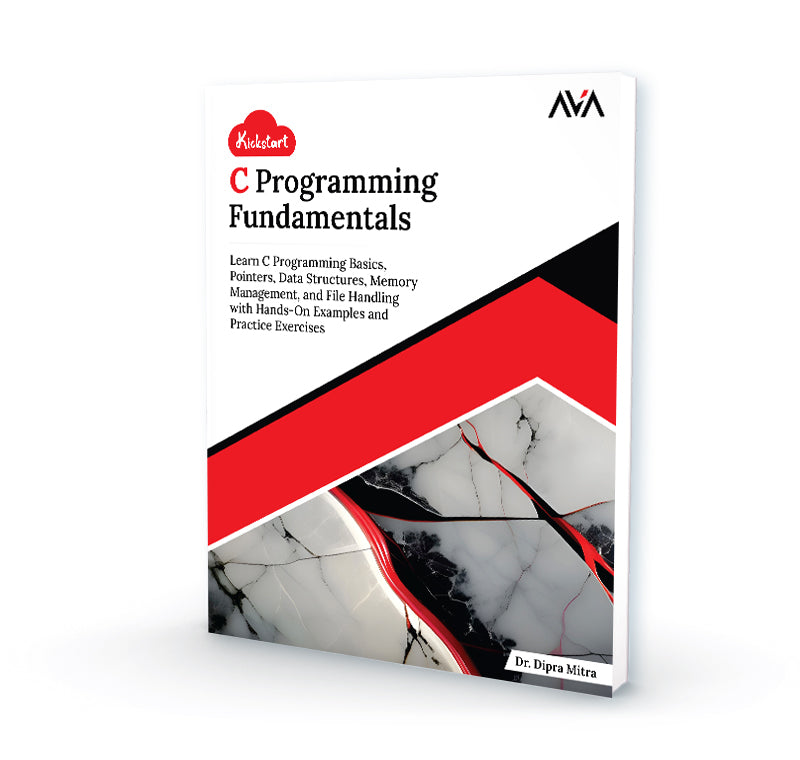
Kickstart C Programming Fundamentals
SKU:9789349887633
Couldn't load pickup availability
Free Book Preview
ISBN: 9789349887633
eISBN: 9789349887237
Rights: Worldwide
Author Name: Dr. Dipra Mitra
Publishing Date: 15-May-2026
Dimension: 7.5*9.25 Inches
Binding: Paperback
Page Count: 183
Share

Collapsible content
Description
Learn C the right way — from first principles to real programs
Key Features
● Get a free one-month digital subscription to www.avaskillshelf.com
● Comprehensive C programming coverage from basic syntax and operators to pointers, recursion, and file handling.
● Practical coding examples and exercises in every chapter to build logical thinking and problem-solving confidence.
● Step-by-step algorithm design and structured programming techniques for writing clean and efficient C code.
Book Description
“C” is the language that underpins operating systems, embedded firmware, compilers, and modern computing infrastructure. This book, Kickstart C Programming Fundamentals, provides a clear, structured introduction to C for beginners, progressing from core syntax and data types to advanced topics, including pointers, recursion, and file handling.
Each chapter introduces concepts through well-explained examples, sample programs, and practice exercises designed to develop logical thinking and problem-solving skills progressively. You will work through variables, operators, control structures, functions, arrays, strings, and structures before advancing to dynamic memory management, algorithmic thinking, and practical file operations. Every topic is presented in clean, readable code with step-by-step explanations that make both basic and advanced concepts accessible.
By the end of the book, you will be well-equipped to write efficient, well-structured C programs with the foundational programming skills needed to pursue careers in software development, embedded systems, and other computing disciplines.
What you will learn
● Understand C programming fundamentals including syntax, data types, and program structure.
● Write efficient C programs using variables, operators, and control flow statements.
● Implement functions, arrays, and strings to build modular, reusable C programs.
● Apply pointers and dynamic memory management for advanced C programming tasks.
● Design algorithms using pseudocode and flowcharts to solve programming problems systematically.
Table of Contents
1. Introduction to C Programming.
2. Arithmetic Expressions and Precedence
3. Branching and Iteration
4. Arrays
5. Algorithms
6. C Function
7. C Recursion
8. Structures and Unions
9. Pointers
10. File Handling and String Handling in C
Index
About Author & Technical Reviewer
About the Authors
Dr. Dipra Mitra is an academician and researcher in Computer Science and Engineering. His research interests include artificial intelligence, machine learning, and smart agricultural technologies. Dr. Dipra is actively involved in teaching, research, and developing innovative solutions that address real-world problems through advanced computing techniques.
About the Technical Reviewer
Sarthak Shah is a Senior Software Engineer and Technical Lead with over a decade of experience designing high-performance, large-scale distributed systems and real-time decision platforms. His work focuses on building low-latency, fault-tolerant infrastructure that powers critical decision-making systems at scale, with deep expertise in systems engineering, cloud-native architectures, and performance-critical programming, including C++.
He has contributed to complex engineering systems across leading technology organizations such as Microsoft, Intel, and Amazon, where his work has centered on designing and scaling backend infrastructure that operates under stringent latency and reliability constraints. At Amazon Ads, he leads the development of real-time evaluation and decisioning systems that process high-volume traffic and enable efficient, data-driven outcomes in production environments.
Sarthak’s technical interests lie at the intersection of distributed systems,
intelligent automation, and agentic architectures, with a focus on integrating AI
into production-grade systems without compromising reliability or performance. He is an active contributor to the broader engineering community through technical reviews and knowledge-sharing initiatives.
He is passionate about building systems that combine rigorous engineering principles with practical scalability, and his work continues to advance the design of resilient, high-throughput platforms for real-world applications.