Skip to product information
1 of 2

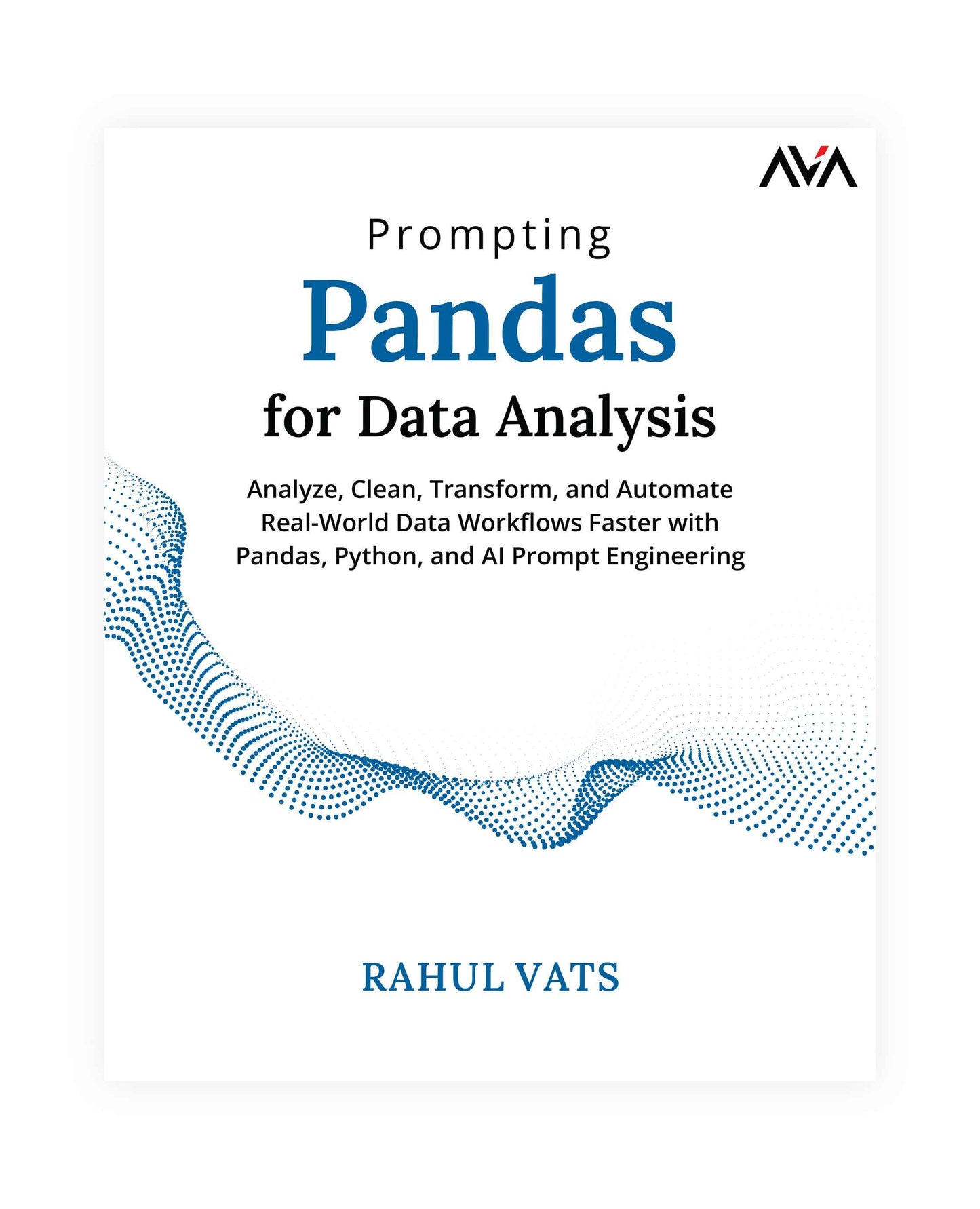
Prompting Pandas for Data Analysis

Prompting Pandas for Data Analysis

SKU:9788169646277

Regular price Rs. 1,499.00
Regular price Sale price Rs. 1,499.00
Sale Sold out
Taxes included. Shipping calculated at checkout.
Quantity
Type

Free Book Preview

ISBN: 9788169646277
eISBN: 9788169646284
Rights: Worldwide
Author Name: Rahul Vats
Publishing Date: 08-July-2026
Dimension: 7.5*9.25Inches
Binding: Paperback
Page Count: 204

Download code from GitHub

View full details

Collapsible content

Description

Ask Better Questions. Generate Smarter Data Insights.

Key Features
● Get a free one-month digital subscription to www.avaskillshelf.com.
● End-to-end Pandas data analysis workflow, from data loading and cleaning to transformation and insight generation.
● Hands-on AI-assisted data analysis using ChatGPT and GitHub Copilot to generate, debug, and optimize Pandas code.
● Prompt-driven data workflows covering filtering, aggregation, time-series analysis, and repeatable pipeline automation.

Book Description
Data analysis is one of the most in-demand skills across every industry — and the ability to move from a question to a working Pandas workflow using AI is rapidly becoming the defining edge for modern data professionals. Prompting Pandas for Data Analysis shows you how to translate natural-language intent directly into working Pandas code using AI, accelerating every stage of data analysis from ingestion and cleaning to transformation and insight generation.

Rather than teaching Pandas from scratch, this book puts AI-assisted execution at the centre. You use prompt engineering techniques to generate data pipelines, debug errors, filter and aggregate datasets, and automate repetitive analysis tasks, then refine and deploy them with confidence. Every chapter is oriented around getting production-ready analytical output faster, not theory.

By the end of the book, you will be ready to use AI prompts as a core part of your data analysis workflow, delivering insights from real-world datasets with greater speed, consistency, and precision.

What you will learn
● Translate natural language into production-ready Pandas workflows for real-world data analysis.
● Generate and refine Pandas code using AI prompts for loading, cleaning, and transforming datasets.
● Prompt your way through filtering, aggregation, and exploratory data analysis with precision.
● Use AI tools to debug, optimise, and improve Pandas workflows for analytical accuracy.
● Automate repetitive data tasks using reusable prompt templates and Jupyter notebook workflows.
● Extract actionable insights from time-series, grouped, and structured datasets using AI-assisted Pandas.

Table of Contents

1. Your First AI-Powered Pandas Workflow: The 30-Minute Head Start
2. Setting up Without Knowing What You are Doing
3. Prompting Your First Real Output
4. Understanding Pandas by Asking Better Questions
5. Building a Real-World Data Pipeline
6. Debugging and Improving with AI
7. Thinking Like a Professional
8. The Transferable Learning Framework
Index

About Author & Technical Reviewer

About the Author:
Rahul Vats
is a Data and AI engineering leader with over 18 years of experience across top enterprises. He specializes in Generative AI, agentic systems, and scalable cloud platforms, helping organizations to build intelligent, AI-driven applications that enhance decision-making, productivity

About the Technical Reviewer

Matthew J. Taylor is a software developer and published author, based in Dallas, Texas. He has spent over 20 years building full-stack software on Unix-based systems, working primarily in Python and TypeScript, alongside Java and React.

Matthew is the author of multiple books available on Amazon, covering Python programming and AI, investment strategy as well as fictions. His first technical book explored how Python and AI-assisted development fit together in practice — a subject that remains central to what he builds daily. He is currently focused on the AI agent ecosystem, where he develops autonomous agent frameworks, LLM- powered applications, and personal knowledge management systems.

Day to day, his output spans data pipelines, agent orchestration, and tooling built on the Model Context Protocol (MCP) standard. He approaches technology as a builder such as simplicity, rapid iteration, and practical results over abstraction. His Python expertise ranges from data analysis and API integration to interactive, AI-augmented workflows. In fact, he reads code the way he writes it — with an eye toward what ships and what breaks.

When not coding, Matthew enjoys walking in nature with audiobooks, creating art, and writing fantasy fiction. Connect with him at https://mjt.dev.