Skip to product information
1 of 2

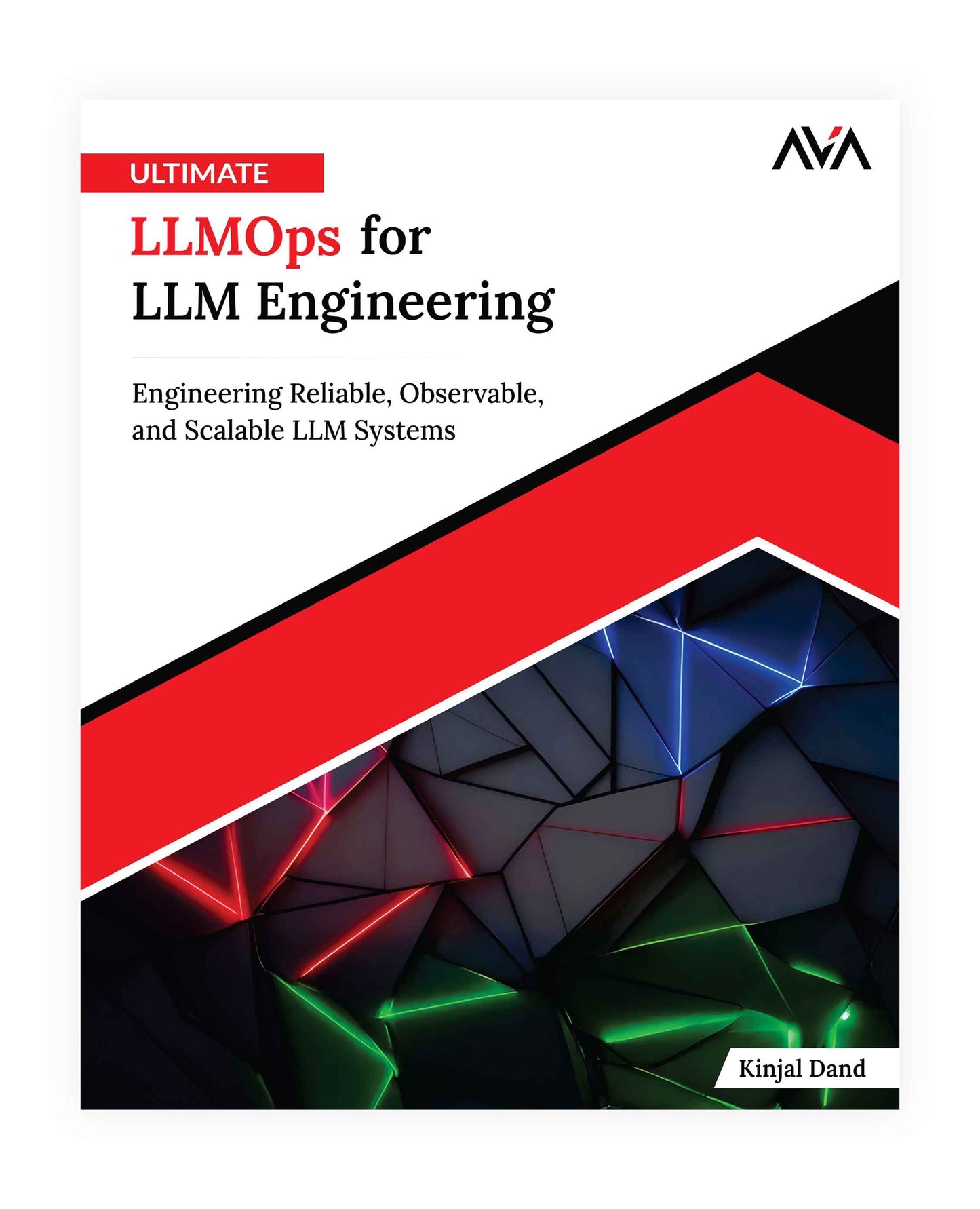
Ultimate LLMOps for LLM Engineering

Ultimate LLMOps for LLM Engineering

SKU:9789349887534

Regular price Rs. 1,999.00
Regular price Sale price Rs. 1,999.00
Sale Sold out
Taxes included. Shipping calculated at checkout.
Quantity
Type

Free Book Preview

ISBN: 9789349887534
eISBN: 9789349887626
Rights: Worldwide
Author Name: Kinjal Dand
Publishing Date: 10-Feb-2026
Dimension: 7.5*9.25 Inches
Binding: Paperback
Page Count: 344

Download code from GitHub

View full details

Collapsible content

Description

From Prototype to Production-Grade LLM Systems.

Key Features
● Get a free one-month digital subscription to www.avaskillshelf.com
● End-to-end coverage of modern LLMOps, from fundamentals to production deployment and monitoring.
● Hands-on prompt management, LLM chaining, RAG, and building AI agent examples.
● Practical insights into LLMOps observability and analytics using LangFuse, Fine-tuning, and securing LLMs in real-world environments.

Book Description
Large Language Models (LLMs) are transforming how organizations build intelligent applications, yet taking them from experimentation to reliable production systems requires a new discipline—LLMOps. Ultimate LLMOps for LLM Engineering
offers a comprehensive journey through the principles, tools, and workflows essential for operationalizing LLMs with confidence and efficiency. It begins by demystifying LLM fundamentals, model behavior, and the evolving landscape of MLOps, giving readers the context needed to design scalable AI systems.

The core chapters dive into hands-on techniques that drive real-world LLM applications, including prompt management, LLM chaining, and Retrieval Augmented Generation (RAG). You will explore how to design LLM pipelines, build effective agentic systems, and orchestrate complex multi-step reasoning workflows. Each concept is supported with practical insights applicable across industries and platforms.

Moving deeper into production, the book equips you with strategies for deploying, serving, and monitoring LLMs in modern cloud and hybrid environments. You will learn how to fine-tune and adapt models, enforce security and privacy requirements, and detect model drift in dynamic data ecosystems.

What you will learn
● Understand LLM foundations and how they integrate with the MLOps ecosystem.
● Build robust prompt strategies, LLM chains, and RAG pipelines for complex workflows.
● Design and deploy AI agents and autonomous LLM-driven systems.
● Serve, scale, monitor, and evaluate LLMs across cloud and on-prem environments.
● Apply fine-tuning, optimization, and adaptation techniques to improve model performance.
● Implement best practices for LLM security, privacy, governance, and drift detection.

Who is This Book For?
This book is tailored for GenAI Developers, Machine Learning Engineers, and Data Scientists who want to build, deploy, and manage LLM-powered systems at scale. Readers should have foundational knowledge of AI/ML concepts, basic NLP familiarity, and experience with Python programming to fully benefit from the content.

Table of Contents

1. Unveiling the World of Large Language Models
2. Getting Started with MLOps
3. Mastering Prompt Management for LLMs
4. The Power of LLM Chaining
5. Retrieval Augmentation Generation
6. AI Agents and Autonomous Systems
7. Deploying Large Language Models
8. Model Monitoring and Evaluation
9. LLM Fine-tuning and Adaptation
10. LLM Security, Privacy, and Drift Detection
11. LLMOps with Langfuse
12. Real-World Examples and Emerging Trends
Index

About Author & Technical Reviewer

Kinjal Dand is a Data Science Architect with more than years in Data Science and Cloud Engineering. She specializes in Machine Learning and Deep Learning solutions, building resilient data pipelines across GCP, AWS, and Azure, and implementing robust DevOps practices. Her work, including "Mastering LLMOps," demonstrates her dedication to pushing LLM innovation.

About the Technical Reviewer
Jay Mangi
is a results-driven machine learning and data science professional with 11 years of IT experience, including seven years dedicated to applied ML, MLOps, and LLMOps across enterprise environments at firms such as EY and Infosys. He specializes in building end-to-end solutions—spanning data ingestion, feature engineering, model development, and production deployment—with a particular focus on Generative AI, Large Language Models (LLMs), and Computer Vision. Jay’s work emphasizes measurable impact, translating complex ML initiatives into tangible outcomes while maintaining robust engineering practices and operational reliability at scale. He holds multiple cloud certifications, most notably the Google Cloud Professional Machine Learning Engineer credential, alongside additional multi-cloud certifications on GCP and Azure. These highlight his fluency in cloud-native ML tooling and production patterns, including orchestration, CI/CD for models, and platform-aligned best practices that reduce time-to-value. Jay is also recognized for his commitment to knowledge sharing and community engagement, helping teams effectively adopt ML solutions across predictive analytics, NLP, and vision domains.

Gaurav Jain
is a technology leader with 15 years of experience in AI, MLOps, LLMOps, systems design, and enterprise-grade solution architecture. He specializes in helping organizations build, scale, and operationalize AI and LLM applications across cloud platforms, including AWS, Azure, and GCP. Gaurav has been honored with the '40 Under 40 Data Scientists' award by Analytics India Magazine. Throughout his career, he has worked across industries with leading organizations such as Deloitte, S&P Global, and Adani, bringing deep domain knowledge and technical leadership to each engagement. Currently, Gaurav serves as a Senior Manager, assisting Fortune 500 companies in defining strategic AI roadmaps, leading AI platform development, and designing scalable architectures. He is also instrumental in driving client partnerships and mentoring junior team members. Gaurav is passionate about enabling organizations to unlock the full potential of AI through robust operational frameworks, scalable architectures, and continuous innovation.