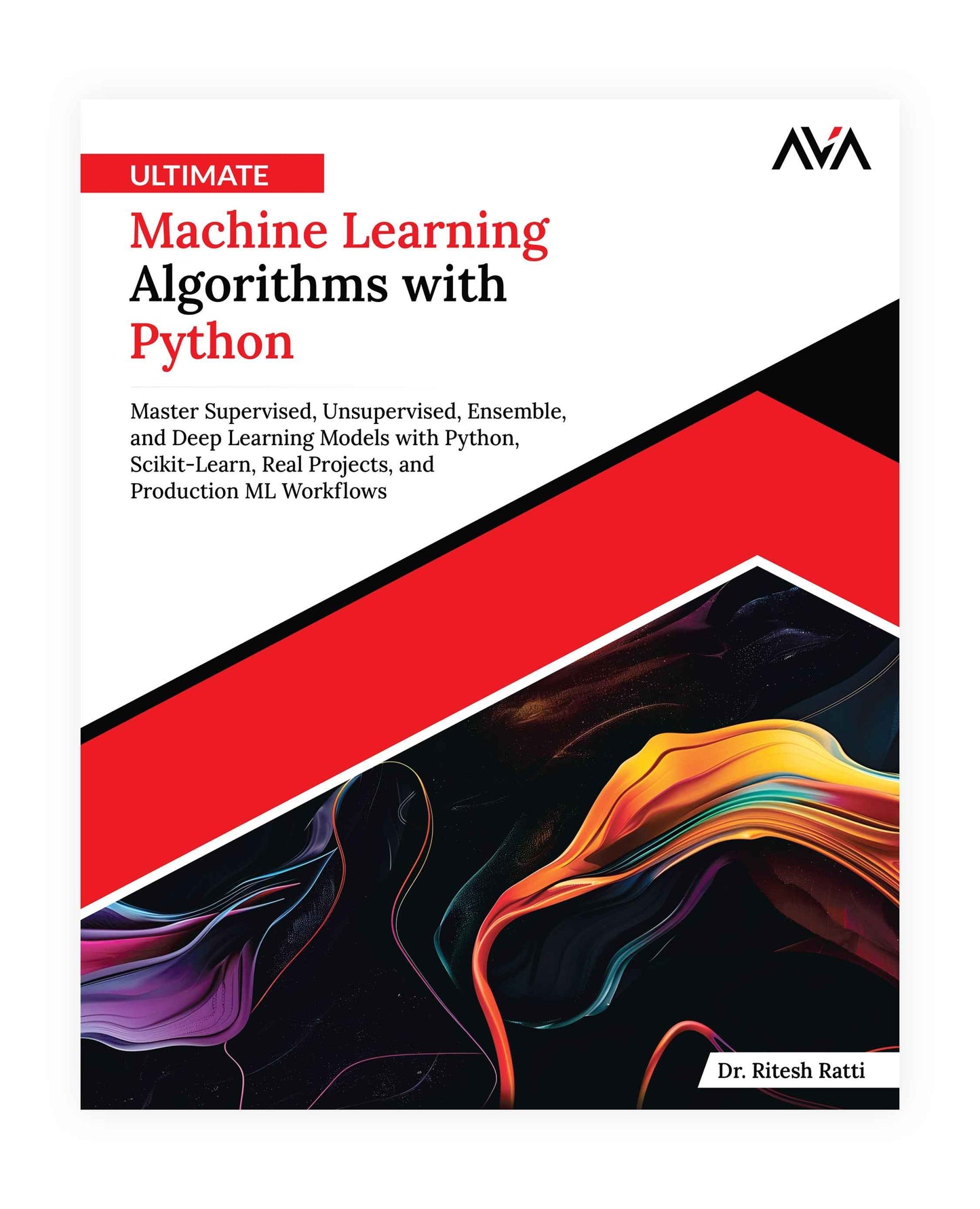
Ultimate Machine Learning Algorithms with Python
SKU:9789349887169
Couldn't load pickup availability
Free Book Preview
ISBN: 9789349887169
eISBN: 9789349887329
Rights: Worldwide
Author Name: Dr. Ritesh Ratti
Publishing Date: 21-May-2026
Dimension: 7.5*9.25 Inches
Binding: Paperback
Page Count: 374
Share

Collapsible content
Description
Learn the Algorithms Powering Modern AI. Build the Intelligence Behind Real-World Decisions.
Key Features
● Get a free one-month digital subscription to www.avaskillshelf.com
● Comprehensive ML algorithm coverage from mathematical foundations to deployment.
● Intuition-driven explanations paired with hands-on Python implementation.
● Guided capstone projects across fraud detection, anomaly, and recommendation systems.
Book Description
Ultimate Machine Learning Algorithms with Python bridges the gap between mathematical understanding and practical implementation, presenting every major algorithm with both theoretical rigour and plain-language intuition, so that readers at any level can build real-world competence.
You begin with supervised learning fundamentals — linear and logistic regression, decision trees, SVMs, and neural networks — before advancing to ensemble methods including Random Forests, XGBoost, and CatBoost. The book then moves into unsupervised learning through clustering, dimensionality reduction, and anomaly detection, with evaluation methods covered in depth for both paradigms. Every algorithm is grounded in a Python implementation using scikit-learn and industry-standard tooling.
The final section puts theory into practice through guided projects — building a fraud detection system, a recommender engine, and a spam classifier — before closing with emerging trends and ethical considerations in ML. By the end of the book, you will be able to select the right algorithm for any problem, tune models for production performance, and communicate results clearly to technical and business stakeholders alike.
What you will learn
● Apply supervised learning algorithms to regression and classification problems.
● Implement clustering and dimensionality reduction for unsupervised tasks.
● Build ensemble models using Random Forests, XGBoost, and CatBoost.
● Evaluate models using appropriate metrics for each algorithm type.
● Develop end-to-end projects in fraud detection and recommendation systems.
● Select, tune, and explain ML models for real business problems.
Table of Contents
1. Introduction to Machine Learning Algorithms
2. Regression Algorithms
3. Classification Algorithms
4. Ensembling Methods
5. Evaluation Methods for Supervised Learning Algorithms
6. Clustering Algorithms
7. Dimensionality Reduction
8. Evaluation Methods for Unsupervised Learning Algorithms
9. Building Recommender Systems
10. Building Anomaly Detection System
11. Building Spam Email Classification
12. Conclusion and Future Trends
Index
About Author & Technical Reviewer
Dr. Ritesh Ratti is an AI and Data Science leader with more than 15 years of experience building cutting-edge ML products. Currently working as Director of AI and Data Science at EY Singapore, he has led teams at HelloFresh, Delivery Hero, Grab, Samsung, and Oracle. Dr. Ritesh holds a PhD in Computer Science (AI & Network Security) from IIT Guwahati with multiple research publications.
About the Technical Reviewer
Himanshu Nayyar is a Staff Software Engineer at Google, specializing in large-scale Machine Learning (ML) modeling and distributed systems. With over a decade of industry experience, his recent work has focused on ads quality, real-time fraud defense, and traffic quality infrastructure. Himanshu holds an undergraduate degree from the International Institute of Information Technology, Hyderabad (IIIT-H).
Riya Joshi is a Data Scientist in Microsoft’s AI division with more than 7 years of industry experience, including prior work as a Data Engineer. She designs and evaluates production-grade Machine Learning (ML) systems for the Microsoft
Edge browser, with a focus on on-device ML, personalization, content understanding, and scalable experimentation.
She holds a Master’s degree in Computer Science and Artificial Intelligence (AI) from the University of Massachusetts, Amherst, and brings a strong foundation in ML theory alongside hands-on experience assessing model design, system trade-offs, performance constraints, and deployment considerations—skills directly relevant to succeed in this opportunity.
Riya actively contributes to the AI community through speaking and mentorship, including talks at PyData Global, PyLadies Con, and Women in Data Science, as well as appearances on the Women in Data and Women in Stem podcasts. As a Career Advisor for the Women in Data Science Career Catalyst program, she has mentored several technologists from over 12 countries, and has been recognized as a top advisor!